![Article image for Why Is Slay the Spire So Fun? [From a Roguelike Developer's Perspective]](/_astro/cover.Cw3ETgZw_26dLGo.webp)
Introduction
Slay the Spire is a roguelike deck-building card game.
I am also making a roguelike game myself, so in this article I will look at Slay the Spire from the perspective of a roguelike developer.
Slay the Spire’s randomness
When you keep playing the same game for a long time, you can end up in a kind of routine play where nothing really moves you, and think, “What am I even doing?”
But this game does not have that kind of routine.
There are so many random elements that you have to keep thinking and making choices at all times.
The particularly important sources of that randomness are the following four elements:
- Deck building
- Stage layout
- Events
- The opening choice
Deck building
After defeating enemies, or through certain in-game events, you get a chance to obtain cards.
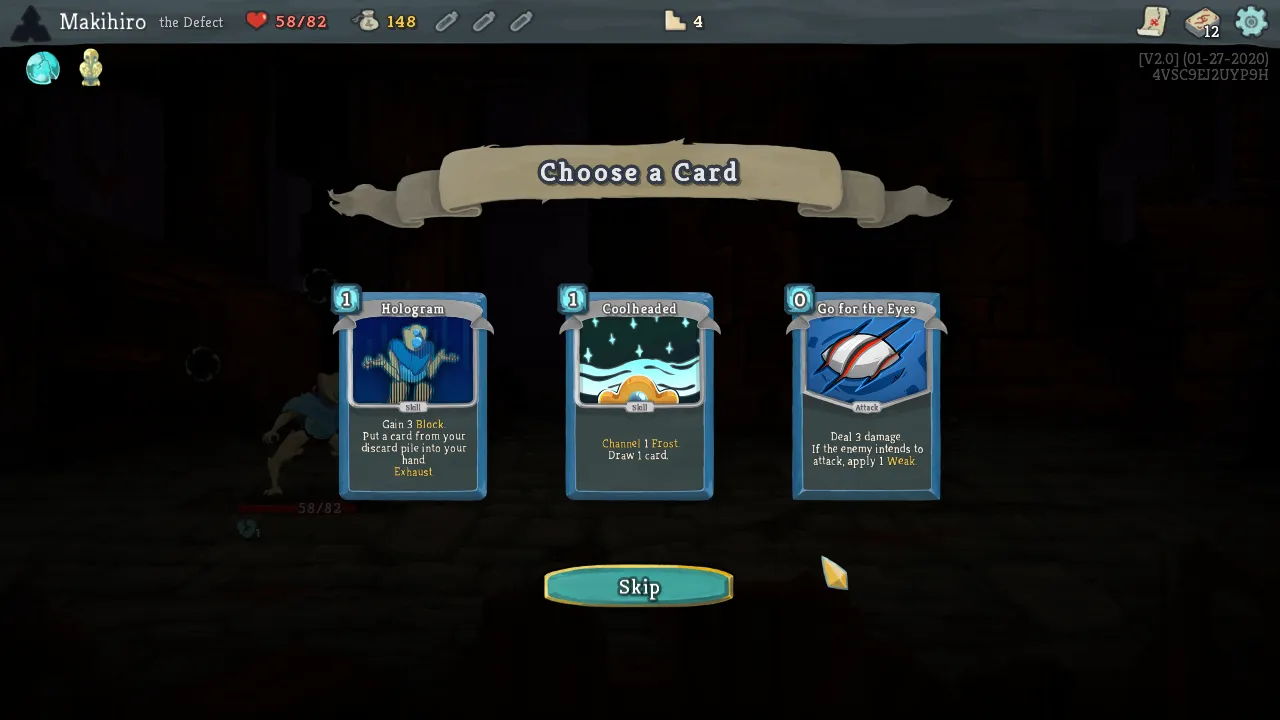
You choose cards by comparing them with the current deck composition. (You can also choose not to take one.)
The cards that appear are random, so there is no such thing as a “template build.”
And precisely because there is no template build, you can enjoy endless trial and error.
A once-in-a-lifetime deck
Every so often, you end up assembling a deck that makes you think, “This is the strongest deck ever!”
But once you defeat the final boss, it is over. You will never assemble that exact deck again.
Forgetting the strongest deck you have ever built and searching for the next strongest one is, I think, one of the pleasures of this game: a true once-in-a-lifetime experience.
Stage layout
In this game, you clear a stage made up of four floors in total, and each stage is randomly laid out, so you need to decide the path you will take each time.
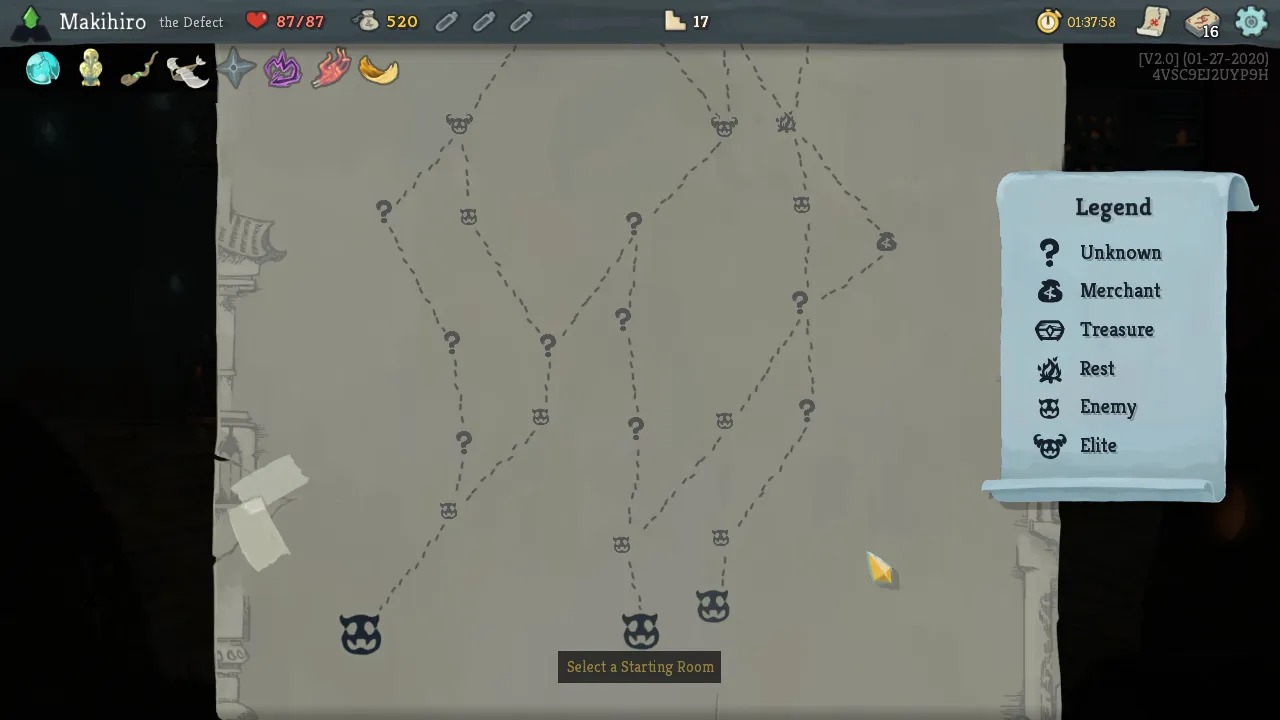
The components of the stage layout are as follows:
| Unknown | An event may happen here. |
| Merchant | A merchant. You can buy cards and other things. The inventory is random. |
| Treasure | A treasure chest. You can obtain gold, cards, and power-up items. What you get is random. |
| Rest | You can either recover HP or upgrade a card. (You choose one.) |
| Enemy | A regular enemy. You get a reward if you defeat it. The enemy that appears is random. |
| Elite | An elite enemy. It is risky to fight, but the reward is better if you win. The enemy that appears is random. |
You decide your route while thinking about all kinds of things, such as “Where should I meet the merchant?” or “Should I fight the elite?”
The stage elements are all random, and among them the most noteworthy are the “?” spaces (Unknown).
Events
When you stop on a “?” space, an event will usually occur. (Sometimes you will run into an enemy or meet a merchant instead.)
And these events contribute the most to the game’s randomness.
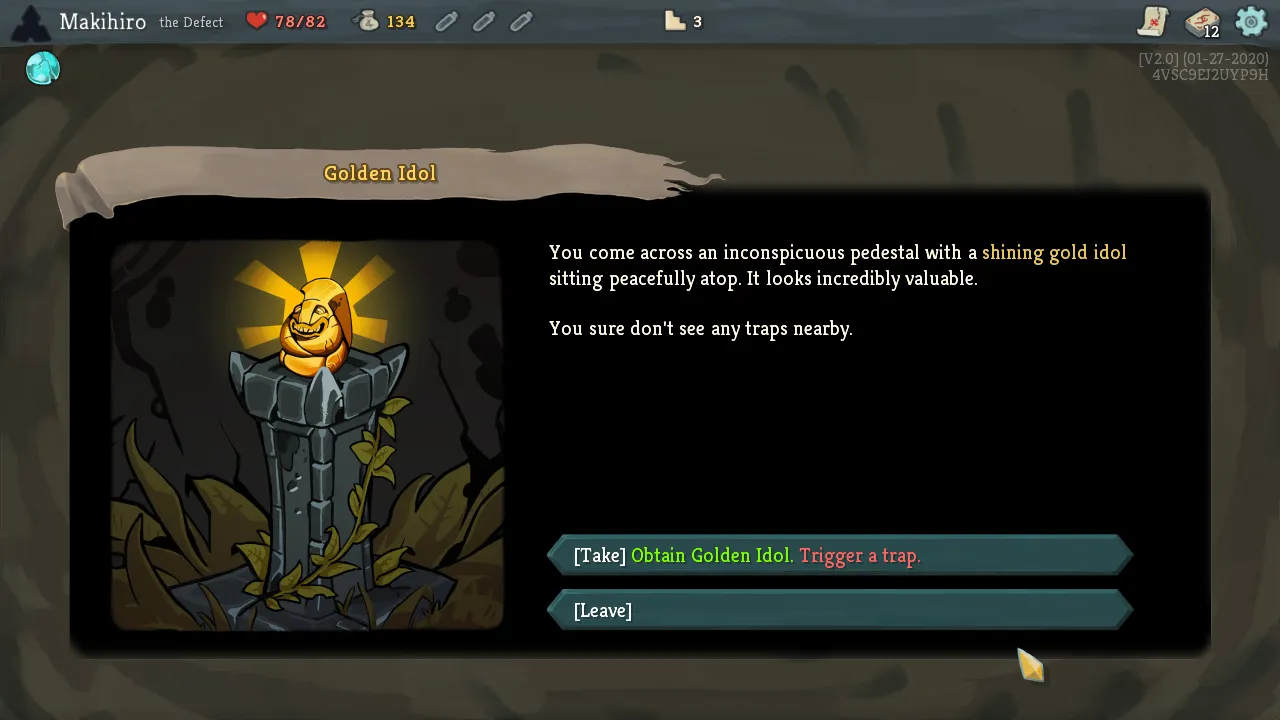
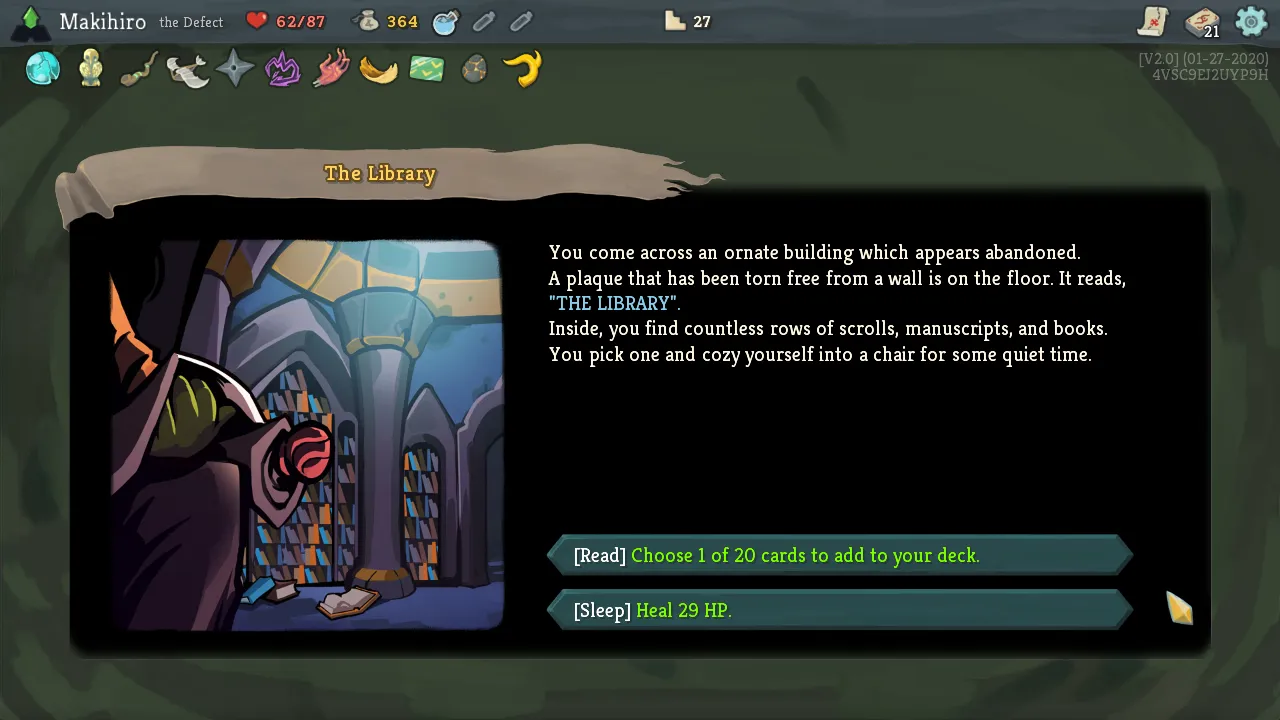
Looking at the Wiki, there are currently 52 events, but in general there are not many that are just “one-sided losses for the player.”
- Events that are simply good, such as “upgrade a card”
- Events where you either “take a risk for a reward” or “take no risk, but get no reward or only a small one”
The unpredictable, positive “?” spaces are exciting.
And players start actively aiming for those “?” spaces, which in turn makes them repeat more randomness-heavy experiences and get hooked on Slay the Spire.
The opening choice
At the start of each run in Slay the Spire, a whale-like creature forces you to make a choice.
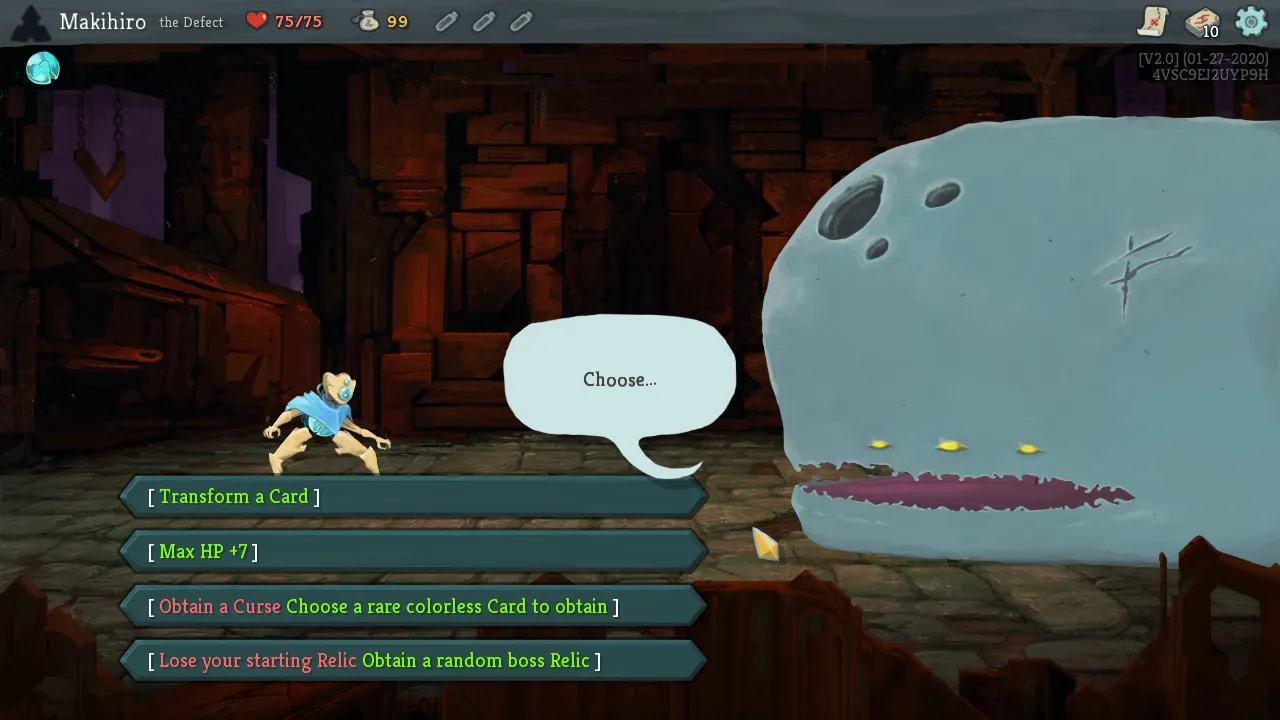
Here are some examples of the choices:
- Increase max HP
- Remove, transform, or upgrade one card from the starter deck
- Obtain a random rare card
- Instead of taking a Curse card, choose a rare card to obtain or a Relic to obtain (an item that strengthens the player)
This opening choice is extremely important for keeping motivation high in the early game.
The starting deck in this game is fixed, so the very beginning can become repetitive. By starting with a random choice, the game boosts the sense of excitement.
A question about one particular choice pattern
One thing I wondered about is that there is a pattern of opening choices that feels uninteresting.
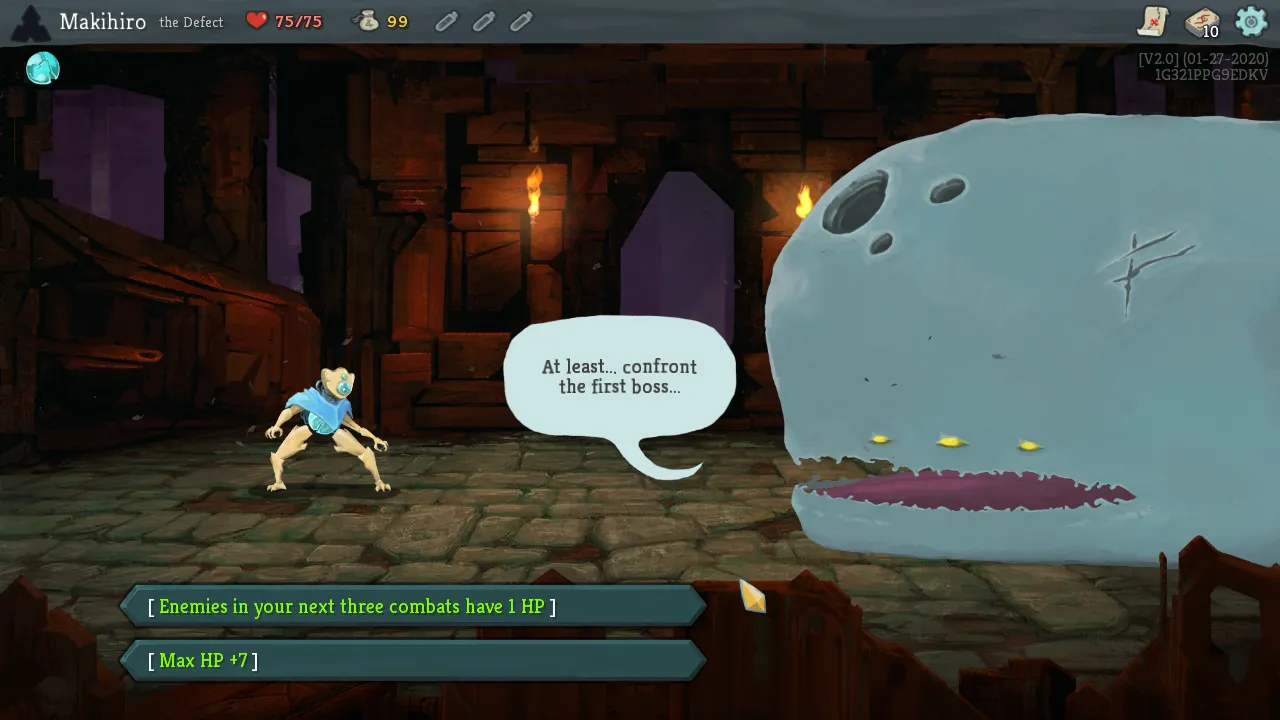
- The HP of the enemies in the first three battles becomes 1
- Max HP increases by 7
Compared with choices that change the deck, this feels pretty bland. Either way is unremarkable, so when this pattern appears, my motivation drops. (By my sense, this pattern appears about 30% to 50% of the time.)
This is the only thing that makes me think, “Why did the developer make this pattern?”
Maybe it is there to create contrast?
One possible explanation is that it is there to create contrast.
“Contrast” means having clear peaks and valleys. Because an uninteresting pattern exists, the exciting choices feel even more exciting, and you end up wanting to hit the Play button again and again. That is one possible interpretation. (Reference: How Contrast Makes Games Fun [Game Design])
You are constantly forced to make choices
That covers the four important sources of randomness.
In this game, every run forces you to make choices over and over again, such as “Which card should I take?”, “Which route should I follow?”, and “Which option should I choose?”
It is no exaggeration to say that there is no moment in this game where you are not making a choice.
To sum it up,
the fun lies in the process of thinking and choosing, and the randomness scattered throughout the game is the mechanism that keeps that process fresh every time
Closing thoughts
If you are interested, give it a try.
https://store.steampowered.com/widget/646570/
I got so absorbed while playing to prepare the reference images that it took me three days to finish writing this article.
References
- An interview with the developers of the indie classic Slay the Spire, about the art of balancing the game. “How can players adapt to what they are given?” Forcing players to work with one-of-a-kind tactical situations
- Slay the Spire - Wiki